
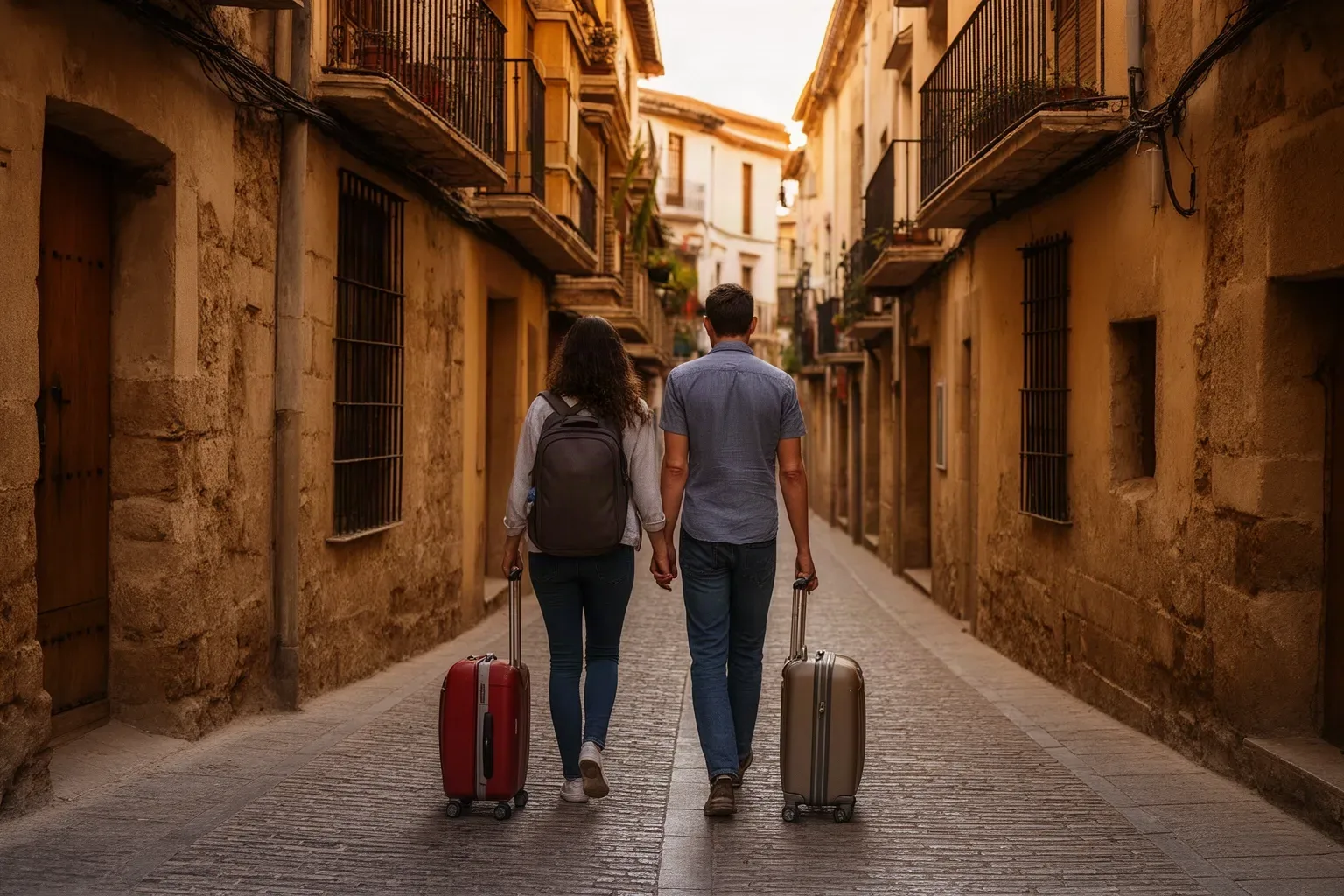
Getting around La Rioja without a car
Quick answer
Without a car, Logroño is easy on foot and by city bus, and there is a regional train to Haro plus buses to Calahorra, Nájera and Santo Domingo – but with few departures a day. For wineries, Rioja Alavesa, mountain villages or the Camino, the practical answer is a private driver, booked per journey or by the hour, with pickup at your hotel and a price agreed in advance.
La Rioja was not designed for car-free tourism. Rural public transport is sparse and most of the wineries, villages and views lie well beyond Logroño. Still, there are workable solutions for anyone who cannot or would rather not drive – and this guide sets them out frankly.
The short version: public transport works well inside Logroño, so-so between Logroño and the main towns, and barely at all for the places most visitors actually come for – the bodegas, the medieval hill villages and the stretches of the Camino de Santiago. Many of our clients from the UK and the US are also simply not keen on driving on the right after a few glasses of Tempranillo, which is wise.
Inside Logroño
The city has a perfectly adequate urban bus network, but the old quarter is pedestrianised and compact, so you will rarely need it. Stay centrally and you can walk to the cathedral, the riverside and the famous tapas streets – our Calle Laurel tapas guide explains how the evening pintxo crawl works.
From Logroño to the rest of the region
Haro
A regional train runs between Logroño and Haro with only a few services a day. If the times suit you, it gets you to Haro, from where the wineries of the Station District (Barrio de la Estación) are within walking distance. The catch is coming back: the last train can cut your afternoon short.
Calahorra, Nájera and Santo Domingo de la Calzada
Intercity buses leave from Logroño, but frequencies are low and the timetables do not always fit a sightseeing day. Getting there is feasible; touring around once you arrive is much harder.
Laguardia and Rioja Alavesa
There is no public transport with timings that work for visitors. Without your own car, the only practical options are a private driver or an organised tour.
Public transport in La Rioja gets you from A to B. Wine tourism needs flexible hours, several stops and the freedom to linger – which is exactly what a bus timetable cannot give you.
What reaches each destination
| Destination | By public transport | With a private driver |
|---|---|---|
| Logroño old town and Calle Laurel | On foot, no problem | Only for arrival or a late return |
| Haro Station District | Regional train, few services; the return limits your day | ~40 min from Logroño; leave when you are ready |
| Laguardia and Elciego | Timetables poorly suited to visits | ~25 min to Laguardia; several wineries in one day |
| Ezcaray and the sierra | Limited connections | ~50 min; easy to pair with Santo Domingo |
| Arnedo, Arnedillo and the Rioja Baja | Bus with few departures | ~45 min to Arnedo; simple to link several villages |
| Camino stages | Buses between some villages only | Pickup at the exact point on the trail |
The complete answer: a private driver
To get around properly – not just from the airport to the hotel, but with real flexibility throughout your stay – an hourly chauffeur in Logroño or a winery day with a driver is the most complete solution. In practice, visitors combine some of these:
- Airport to hotel: an easy arrival from Bilbao, Madrid, Zaragoza or any of the other airports we serve.
- Winery day: a driver for your day in Haro or Rioja Alavesa – hotel pickup, visits, waiting time and the drive back. See our winery visits with a driver for ideas.
- Chauffeur by the hour: errands, appointments or any trip in and around the city.
- Hotel to station or airport: for the journey home, without hunting for a taxi.
Three days without touching a steering wheel
- Day 1 – Arrival. We collect you from the airport or station and drop you at your Logroño hotel. In the evening, a stroll and tapas in the centre, all on foot.
- Day 2 – Wineries. A full day with a driver around Haro or Rioja Alavesa. Nobody drives, everyone tastes, and the car is waiting outside each bodega. Our guide on how to plan a Rioja wine route helps you pick the stops.
- Day 3 – Villages and departure. A morning in Santo Domingo de la Calzada or Ezcaray, then straight on to your train or flight.
Want a longer plan? Our La Rioja in 3 days itinerary fills in the detail.
Reduced mobility or travelling with children?
Rural buses become even trickier with wheelchairs, pushchairs or lots of luggage. For these situations we offer dedicated accessible transport in La Rioja and a family transfer with luggage. Tell us what you need when you ask for a quote and we will suggest the right vehicle.
Walking the Camino?
The Camino Francés crosses La Rioja from Logroño to Grañón, via Navarrete, Nájera and Santo Domingo de la Calzada. Walking obviously needs no car, but you may want to skip a stage, collect someone from your group or send your rucksack ahead to the next hostel. Our Camino de Santiago transfers cover all of that, and the guide to walking the Camino Francés through La Rioja describes each stage.
Half day or full day: how long to book
A common question is how many hours to reserve. It depends on distance and what you want to do once there. As a rough guide from Logroño:
- Laguardia or Nájera (about 25 minutes): half a day covers one winery or the monastery, a wander and lunch back in town.
- Haro or Santo Domingo de la Calzada (about 40 minutes): half a day for a single visit; a full day for two wineries and lunch locally.
- Calahorra or Arnedo (40–45 minutes): fits neatly into a morning, leaving the afternoon free.
- Ezcaray (about 50 minutes): worth a whole day, especially combined with Santo Domingo or a walk in the hills.
The price is fixed before you set off, based on the planned route and time. If you decide to stay longer somewhere or add a stop, simply tell your driver and we confirm the change before it happens – no surprises at the end of the day.
Practical tips for car-free travellers
Stay near the centre. Sleeping close to Logroño's old town means you can do almost everything on foot and only book a car for excursions. Group your outings. Rather than many short hops, concentrate trips outside the city into one or two driver days. Book your return early. The last train or bus can leave surprisingly early; with a transfer to the airport or station already arranged, you can enjoy your final day without watching the clock.
Frequently asked questions
Is public transport in La Rioja any good?
Within Logroño it works well. Between towns and out to wineries, medieval villages or the Camino, services are sparse and timetables are not geared to visitors.
Can I visit Rioja Alavesa without a car?
Yes, but realistically only with a private driver or an organised tour. Public transport to Laguardia or Elciego does not run at times that suit sightseeing.
Is there Uber in Logroño?
Ride-hailing apps have very limited coverage in Logroño. Rioja Transfer is a licensed private-hire (VTC) operator covering the whole of La Rioja, available with advance booking.
Can I take the train from Logroño to Haro?
Yes, there is a regional line with a few services a day. It works if the times suit you, but check the last train back before you set off.
Exploring La Rioja without a car?
We handle every journey: airport, wineries, villages and the trip home. Fixed price, no surprises.